FOR IMMEDIATE RELEASE (415) 344-0489 mary@livablecity.org
***PRESS RELEASE***
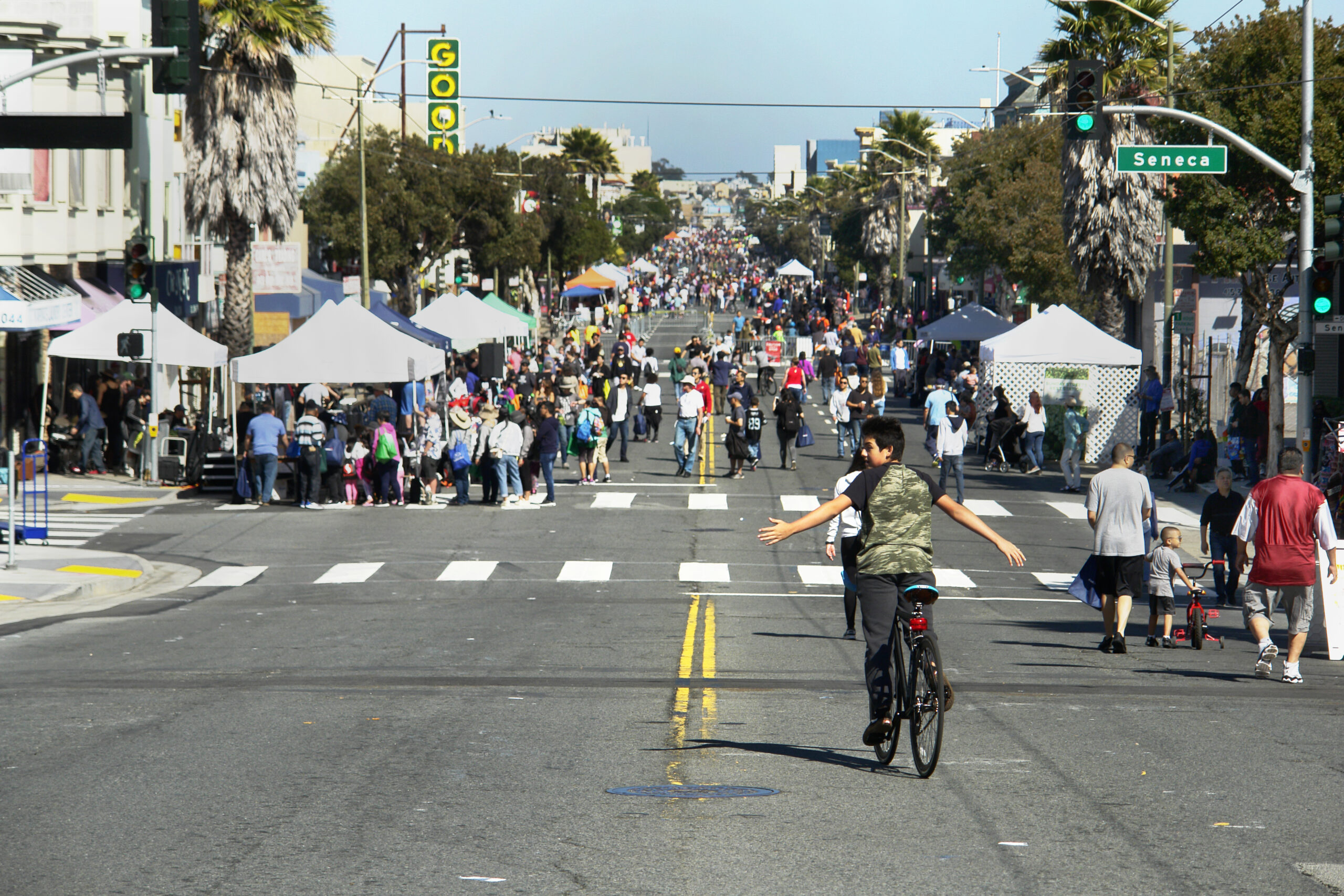
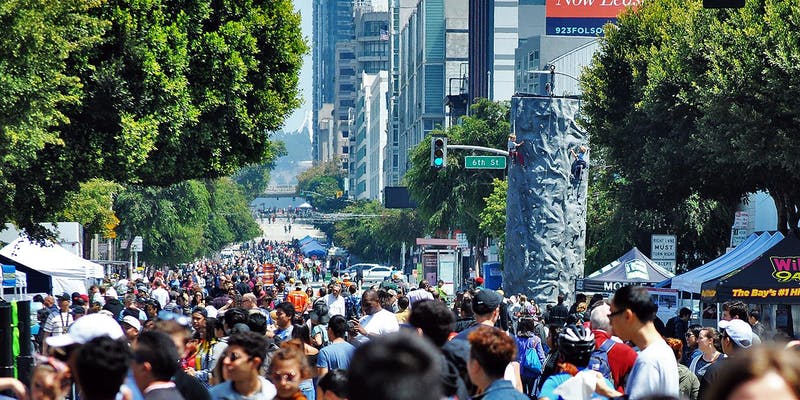
San Francisco – Sunday Streets comes to the Excelsior district on March 31 from 11am-4pm, transforming Mission Street from Silver to Geneva Avenue into on open street with free activities, live music, health resources, a local goods Market Square, Picnic Grounds and more.
“Sunday Streets brings together San Franciscans from all walks of life to enjoy our city’s open spaces and strengthen our communities,” said Mayor London N. Breed. “Our city is known for its beauty and its landmarks, but what really makes it great is our people. Sunday Streets gives our residents the chance to enjoy together the best of what San Francisco has to offer.”
Visit Activity Hubs at Cotter, France and the Persia Triangle, where residents of all ages can experience a pop-up community park and Petsville with a dog adoption event and SFPD’s equine unit. At France Street, enjoy a Market Square and Picnic Grounds, and pick up a Common Cents Passport at a Sunday Streets Info Booth to get stamped (and win prizes from!) local businesses. And don’t forget to pick up the Explore Local Guide for a fun map of the ‘hood you can use all year long.
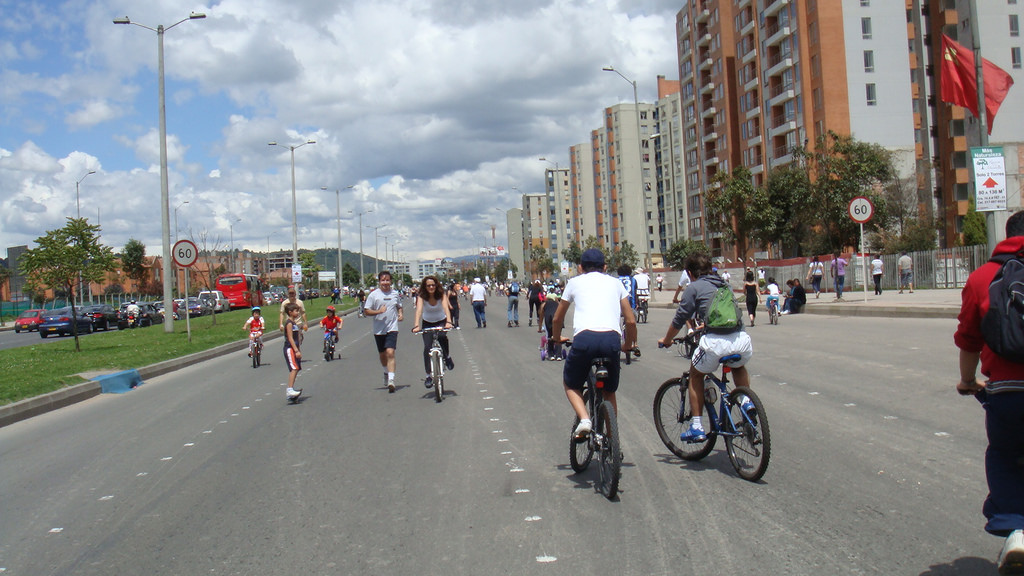
Inspired by the Ciclovía in Bogotá, Colombia, Sunday Streets is a series of free, fun events empowering local communities to transform one to four miles of car-congested streets into car-free community spaces for kids to play, seniors to stroll, organizations to connect and neighbors to meet. Over a mile of cultural performances, health resources, live music and open space provides free opportunities for all at ten yearly events.
Nonprofit Livable City runs both Sunday Streets and Play Streets, a program empowering neighbors to transform their block into an accessible, car-free open space on a regular basis. Both programs are sponsored by the SFMTA and other City agencies, and Sunday Streets would not be possible without crucial services like Muni bus re-routing or traffic control officers for public safety.
Project experts from SFMTA and Vision Zero will be on hand throughout the season, providing neighborhood residents and visitors direct access to transit planners and ambassadors dedicated to sustainable streets.
Small businesses, residents, nonprofits and local groups bring activities, volunteers and performances to the car-free routes, with each contributing a distinctive character and energy to the day. A local hire program employs San Francisco residents for outreach and event-day support.
Transforming miles of car-dominated City streets into open space is possible through the collaboration and hard work of hundreds of volunteers, neighbors, nonprofits and small businesses. Donate, exhibit, volunteer or sponsor Sunday Streets in 2019 to be part of a sustainable, greener and more accessible future. For more information, visit www.SundayStreetsSF.com.
Sunday Streets 2019 Season Schedule
March 10 – Mission 1
March 31 – Excelsior 1
April 14 – Tenderloin 1
May 5 – Bayview/Dogpatch
June 9 – Sunset/GGP
July 14 – Mission 2
August 18 – SoMa
September 8 – Tenderloin 2
September 22 – Western Addition
October 20 – Excelsior 2
The Sunday Streets 2019 season is made possible by the following season sponsors: Bay Area Air Quality Management District (BAAQMD), San Francisco Department of Children, Youth & Their Families (DCYF), Mission Housing Development Corporation, San Francisco Department of Public Works (SFPUC), Genentech, Office of Economic and Workforce Development (OEWD), Sutter/CPMC, Ford GoBike, iHeartMedia, Skip, Sutter/CPMC, iHeart Media, Jump Bikes and Xfinity/Comcast
About Sunday Streets
Sunday Streets is a program of the nonprofit Livable City, presented in partnership with the San Francisco Municipal Transportation Agency and the San Francisco Department of Public Health and the Shape Up SF Coalition. Additional City support comes from the Department of Public Works, Recreation & Parks Department, SF Police Department, SF County Transportation Authority, San Francisco Mayor London Breed and her offices and the SF Board of Supervisors.
About Livable City
Livable City is dedicated to increasing affordable housing, improving transportation, land use, open space, and environmental policies, and supporting grassroots initiatives to make San Francisco a safer, healthier, and more accessible city. For more information on Livable City, visit:https://livablecity.org. For more information about Sunday Streets, including the Sunday Streets event activity guide, visit:www.SundayStreetsSF.com. For information on Muni routes and vehicle access, call 511 or go to www.sfmta.com
In 1974, Bogotá, Colombia began an experiment that would help shape a worldwide movement. That year, bicycling and recreation advocates piloted a program that closed city streets to cars to open them up for cycling and recreation.
“When I came back home to Bogotá, I was shocked to see that we Colombians were following the American path of urban development. Cars and more cars. One person, one car. It was obvious that this was not going to lead to a livable city, “ original Ciclovía organizer Jaime Ortiz Mariño told Bicycling Magazine.
In the 1990s and early 2000s, Mayor Enrique Peñalosa and his brother, parks commissioner Gil Peñalosa, increased the route to 70 miles, creating the expansive, nearly-citywide Ciclovía enjoys today. City parks are also opened up during the events so citizens can benefit from free exercise classes, and numerous studies have been conducted on the positive public health impacts. In economically stratified cities, open streets improve social connection too, providing a space all people can come together, regardless of wealth or status.
Nearly two million people turn out for Ciclovía, which takes place every Sunday and most holidays from 7 a.m. to 2 p.m. Though it has faced some challenges – including a congressman who tried to outlaw the program, saying it led to car traffic – the event has become an international touchstone and the inspiration for almost every open street program today, including Sunday Streets. The word, meaning “bike path” or “cycle way” has become synonymous with open streets.
As the fourth-largest city in Colombia, Bogotá is a sprawling industrial and economic center, with nearly 8 million inhabitants. It’s so crowded that car travel is restricted via license plate during peak hours, and heavy industry, vehicle traffic and a mountainous location lead to poor air quality.
But Bogotá is also a city shaped by Ciclovía and its champions, with over 200 miles of bike paths, and a city mandate that all new streets include bike lanes.
The transit and sustainability issues the city still faces point to the need for policy and legislation to work hand-in-hand with actionable interventions. But the success and permanency of a program many never imagined would succeed shows that a major metropolis can create mode shift, transforming car-dominated streets on a massive, nearly citywide scale weekly. As we envision a sustainable future, Ciclovía is a reminder that a city can thrive without cars on a scale few would have ever thought possible.
How did a dense, car-dominated, 49-square-mile city with multiple freeways launch the country’s largest open streets program?
Now in its 11th year, Sunday Streets San Francisco continues to expand its routes and programming to provide car-free community space for all.
Learn the story of how Sunday Streets got off the ground – and into the streets!
By Marynoel Strope
The First Year
In 2008, then-San Francisco Mayor Gavin Newsom decided it was time to address two major public health crises. Reports showed chronic disease on the rise locally, especially among people of color and low-income communities lacking access to parks, gyms and open space, while fossil fuel consumption led to climate change, threatening public health worldwide. Together with public health and sustainability advocates from across the city, he landed on open streets as the solution and piloted the very first Sunday Streets that year.
The first-year pilot provided 4.5 miles of temporary car-free space along the waterfront between the Bayview and Chinatown during two dates in August and September. It was inspired by Bogotá, Colombia’s Ciclovía, the world’s longest-running and premiere open streets program.
San Franciscans, especially families, turned out for the car-free events that provided miles of safe, recreational space in increasingly traffic-dominated roadways. What’s more, open streets created a model for a sustainable future, allowing residents to see their streets as public spaces and envision a world not reliant on fossil fuels.
“We have created a new tradition in San Francisco that will improve our quality of life for years to come,” Newsom said after the first event.
Newson presented the Sunday Streets pilot along with the Shape Up SF Coalition, a group comprised of policy nonprofit Livable City, SF Department of Public Health (DPH), SF Department of Children, Youth and their Families (DCYF), SF Bicycle Coalition, WALK SF, the YMCA and many more public health and sustainability advocates.
“It really was a citywide push with community partners, side by side and hand in hand,” said DPH Senior Health Program Planner Christina Goette of the program’s first year.
In transportation terms, it was a blank canvas for advancing mode shift, creating a space that made walking, biking and public transit the best (and only) option to take along the waterfront those two days in 2008. For the first time in San Francisco, the city and state’s largest source of greenhouse gas emissions – automobile traffic – was curbed on a large scale for public health.
Growing Up
In 2009, Newsom declared Sunday Streets permanent as it rolled out new long routes on 24th Street in the Mission, the waterfront and multiple Great Highway dates. In 2010, the program expanded to include routes dedicated to neighborhoods like the Tenderloin and Bayview (see the route history below). Routes have changed over the years due to logistics and community feedback, but all have been a minimum of one mile in length and aim to become permanent staples in the neighborhood, with many now enjoying a spring and fall session of Sunday Streets.
A study released in 2011 from Dr. Susan Zieff, Professor of Kinesiology at SF State University, showed the positive health impacts of the events – attendees not only got their weekly exercise on the mile-plus routes, but 25 percent reported a positive change in their overall physical activity. With data to back it up, Sunday Streets could now confidently claim more than just fun in the sun and had the legs of a real public health intervention.
The Leaders
In a field usually dominated by men, female program directors shaped the course of Sunday Streets. Susan King set the program on its path, choosing Livable City, led by Executive Director Tom Radulovich, as the program’s day-to-day operator. King continues to advocate for sustainability and open streets across the Bay Area.
Beth Byrne followed King, increasing outreach efforts and establishing the program as one of the City’s exemplary models for neighborhood notification. The City recognized December 8, 2015 as Beth Byrne Day in San Francisco for her service and advocacy in the city. Liza Pratt came after Byrne, refining the logistics infrastructure that informs the successful public/private partnership the program relies on today.
Current Programs and Development Director Katy Birnbaum is the first woman of color to lead Sunday Streets, and her focus on collaboration has expanded both community engagement and culturally relevant programming at Sunday Streets. Working closely with residents and stakeholders – from faith leaders to local merchants to cultural districts – Birnbaum’s emphasis isn’t just about bring resources to underserved neighborhoods, but about helping neighbors realize the resources within their own communities.
An Institution Is Made
In 2018, the program celebrated a decade of open streets with a landmark 10 events across six neighborhoods adding its first new route in five years on Folsom Street in SoMa, which featured the first-ever Sunday Streets food and goods marketplace produce by SOMA Pilipinas’ Undiscovered SF Night Market in celebration of the district’s historic Filipino population.
What was once a city pilot project was now a San Francisco institution with a mission to foster public health and community-building, and inspire people to think differently about their streets as public spaces.
Today, Sunday Streets provides free recreation and health resources and over 15 miles of open streets yearly during ten annual events.
January 31st, 2019
FOR IMMEDIATE RELEASE
Mary Strope
(415) 344-0489
mary@livablecity.org
***PRESS RELEASE***
Sunday Streets Brings Over 15 Miles of Temporary Parks to San Francisco
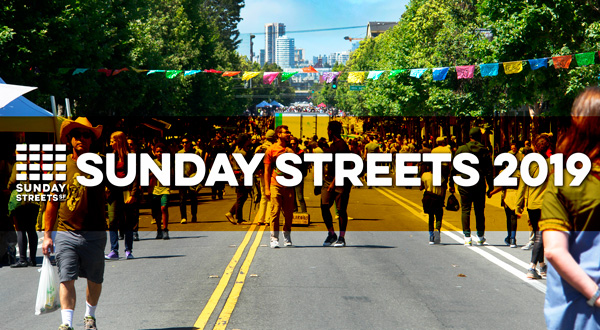
San Francisco – Livable City is excited to announce the 2019 season of Sunday Streets, the country’s largest open streets program, with ten citywide events across San Francisco from March to October. Join the international open streets movement – the magic begins with Sunday Streets Mission on March 10.
Inspired by the Ciclovía in Bogotá, Colombia, Sunday Streets is a series of free, fun events empowering local communities to transform one to four miles of car-congested streets into car-free community spaces for kids to play, seniors to stroll, organizations to connect and neighbors to meet.
“Sunday Streets is part of a global open streets movement,” said Programs Director Katy Birnbaum. “Across the world, people are reclaiming their streets from cars and opening them up to the community. It’s about public health, free recreation, meeting your neighbors and envisioning a future where public space is for people, not auto traffic.”
Sunday Streets free events feature active play games, cultural performances, health resources, live music and more from 11am-4pm in diverse neighborhoods across the City, including the Mission, Excelsior, Tenderloin, Bayview and Dogpatch, Outer Sunset, Western Addition and newest route, SOMA.
Nonprofit Livable City runs the program, and is sponsored by the SFMTA and other City agencies. Sunday Streets is made possible with crucial services like Muni bus re-routing or parking control officers for public safety. Project experts from SFMTA and Vision Zero will be on hand throughout the season, providing neighborhood residents and visitors direct access to transit planners and ambassadors dedicated to sustainable streets.
Small businesses, residents, nonprofits and local groups bring activities, volunteers and performances to the car-free routes, with each contributing a distinctive character and energy to the day.
For local businesses, Sunday Streets offers the fun, reusable Explore Local map, the Common Cents Passport for brick-and-mortars and a Market Square in select neighborhoods featuring local vendors and makers. A local hire program employs San Francisco residents for outreach and event-day support.
“Sunday Streets shows sustainable transportation in action,” said SFMTA Director of Transportation Ed Reiskin. “Walking or biking the car-free route and taking public transit to get there is a healthful, fun and environmentally friendly way of getting around the City.”
Transforming miles of car-dominated City streets into open space is possible through the collaboration and hard work of hundreds of volunteers, neighbors, nonprofits and small businesses. Donate, exhibit, volunteer or sponsor Sunday Streets in 2019 to be part of a sustainable, greener and more accessible future. For more information, visit SundayStreetsSF.com.
The Sunday Streets 2019 season is made possible by the following season sponsors: Bay Area Air Quality Management District (BAAQMD), San Francisco Department of Children, Youth & Their Families (DCYF), Office of Economic and Workforce Development (OEWD), Sutter/CPMC, Golden State Warriors, iHeartMedia, Scoot, Xfinity/Comcast and Bi-Rite. Sunday Streets also thanks the following event sponsors: Mission Housing Development Corporation, Dolby and Wu Yee Children’s Services and is excited to welcome these exhibitors: Provident Credit Union, Farm Fresh to You / Capay Organic and Scoot.
About Sunday Streets
Sunday Streets is a program of the nonprofit Livable City, presented in partnership with the San Francisco Municipal Transportation Agency and the San Francisco Department of Public Health and the Shape Up SF Coalition. Additional City support comes from the Department of Public Works, Recreation & Parks Department, SF Police Department, SF County Transportation Authority, San Francisco Mayor London Breed and her offices and the SF Board of Supervisors.
About Livable City
Livable City is dedicated to increasing affordable housing, improving transportation, land use, open space, and environmental policies, and supporting grassroots initiatives to make San Francisco a safer, healthier, and more accessible city. For more information on Livable City, visit: https://livablecity.org. For more information about Sunday Streets, including the Sunday Streets event activity guide, visit: www.SundayStreetsSF.com. For information on Muni routes and vehicle access, call 311 or go to www.sfgov.org/311.
On December 21, the Mayor signed Supervisor Jane Kim’s ordinance eliminating minimum parking requirements citywide. The ordinance goes into effect on January 20.
In October, the City’s Planning Commission unanimously recommended removing citywide parking requirements as part of their review of legislation to limit new driveways along the City’s most important transit, walking, and cycling streets. Given the choice of adding more caveats to the Planning Code’s parking exceptions or eliminating minimums, the commission opted to recommend doing away completely with minimum requirements. Supervisor Kim agreed to act on their strong recommendation. The legislation was heard twice at the Board of Supervisors’ Land Use and Transportation Committee, with City and Bay Area environmental, sustainble transportation, and housing advocates – Livable City, Walk San Francisco, SF Bicycle Coalition, Transform, SPUR, Housing Action Coalition, and YIMBY Action – testifying in favor of the legislation, along with the City’s Planning Department, SFMTA, and Transportation Authority. At the full board, supervisors Kim, Brown, Mandelman, Peskin, Ronen, and Tang voted in favor.
Recent research continues to confirm what wise urbanists and planners have known for decades. Minimum parking requirements increase auto traffic in cities, and with it pollution and congestion. Minimum parking requirements make cities less healthy and less sustainable. Private cars are now the largest source of greenhouse gases in California, and an increasing one. Minimum parking requirements make housing more expensive to build, to rent, and to buy. Minimum parking requirements replace storefronts, walk-up housing, front gardens, and street trees with garage doors and driveways, making our neighborhoods and sidewalks less safe, less accessible, less green, and less appealing for people walking, cycling, and riding transit, particularly seniors, children, and people with disabilities.
Minimum parking requirements are an anachronism, a relic of the post-World War 2 project to retrofit walkable, compact, and transit-rich cities like San Francisco for domination by the automobile. The automobile-obsessed planning of that era imposed parking requirements, bulldozed freeways through city centers and urban neighborhoods, narrowed sidewalks and widened neighborhood streets into traffic sewers, tore up streetcar tracks, and displaced homes and businesses to build parking lots and garages.
That 1950s project was disastrous for cities, and citizens rose up to reclaim their streets and neighborhoods. San Francisco’s freeway revolt from 1959 to 1966 stopped urban freeway construction, and the City removed the earthquake-damaged Embarcadero and Central freeways after the 1989 quake. In the 1960s San Franciscans voted to build BART and the Muni Metro under Market Street, and later voted to rebuild streetcar lines, extend Caltrain, and expand and improve bus and ferry service. In the 1970s, the city began successful experiments with neighorhood traffic-calming, and started to install bicycle lanes in the 1990s. For decades the City has embraced, and affirmed and reaffirmed at the ballot box, a transit-first policy and a multi-modal transportation strategy that invests in transit, walking, and cycling and seeks to keep auto traffic in check.
Minimum parking requirements are incompatible with the livable, walkable, green, and sustainable urban future that San Franciscans prefer. Since the 1970s, the City has chipped away at the strict minimum parking requirements imposed in the 1950s, first Downtown and then outwards along some of the City’s many bus and rail corridors. The incremental approach has been successful. Neighborhood plans removed parking requirements in some places, while Livable City has worked with Supervisors to remove minimum requirements in many more neighborhoods, and for specific uses and circumstances. In 2007 voters overwhelmingly rejected Proposition L, which would have re-imposed minimum parking requirements outside the Downtown. In the past few years, the City has exempted accessory dwelling units and projects with increased affordability from minimum requirements citywide.
When eliminating minimum parking requirements is discussed, some people hear “ban on cars”, and start arguing why they or other people need a car for this or that, or how transit, walking, and cycling aren’t convenient enough or safe enough. Removing minimum parking requirements isn’t a ban on parking and driving. It makes automobility a choice rather than a government mandate. About a third of San Francisco households are car-free, and the majority of new households are car-free. Households who choose to do without a car can avoid the cost of buying, maintaining, and storing a car. Keeping minimum parking requirements in place does nothing to improve sustainable transportation options, and, by increasing traffic congestion and eroding the safety and utility of sustainable modes, makes the entire transportation system work worse. Removing parking mandates complements expanding sustainable transportation options, and better managing curb parking and loading. Relaxing parking requirements can even make living with cars easier, by reducing traffic congestion and turning unused driveways back into curb parking spots.
Reducing parking requirements is a national movement, as Strong Towns’ interactive map illustrates. San Francisco wouldn’t be the first US city to eliminate minimum parking requirements citywide – Hartford, Connecticut eliminated them last year. Finally eliminating minimum parking requirements would make San Francisco a progressive leader in the movement to reclaim cities for people, and in addressing the City’s escalating crises of housing affordability and automobile congestion, and easing the linked global environmental crises caused by automobile dependence.
The results of the November 6 election are mostly counted.
The big national news is that the Democratic Party will control the House of Representatives for the next two years, breaking the Republicans’ monopoly on national government.
Democratic control of the House will likely slow, or even stop, Republicans’ unprecedented attempts to dismantle laws that protect the environment and public health, and reduce federal funding and programs for housing and public transportation.
Voters in San Francisco, the Bay Area, and California supported measures to provide more housing for Californians in need, improve transportation, and expand green public open space.
California voters approved Proposition 1, a new $4-billion general obligation bond to build and rehabilitate affordable housing, and fund homebuyer assistance programs for qualifying households and veterans. Voters also approved Proposition 2, which allows current state funds earmarked for mental health to be used to provide housing for Californians in need of mental health services. Prop 2 is part of a growing movement to integrate approaches to housing and health.
Voters also rejected Proposition 6, which would have rolled back California’s 2016 increase in fuel taxes to fund transportation across the state. Fuel taxes had not kept pace with inflation, and California’s transportation spending has fallen far behind what’s needed to keep our transportation system – sidewalks, public transportation, bicycle access, roads, and highways – operating safely and effectively, and in good repair. Taxing fossil fuels also encourage Californians to drive less, use sustainable transportation options, and choose more fuel-efficient, less polluting, and non-fossil-fueled vehicles.
In San Francisco, voters strongly approved Proposition C, which increased the City’s gross receipts tax on large corporations to fund homeless services, shelters, and housing. San Francisco voters also approved Proposition A, a bond measure that will fund repairs to the City’s century-old seawall along the Bay shore so it can better withstand large earthquakes and sea-level rise.
Voters in Brisbane approved Measure JJ, which authorizes amendments to Brisbane’s general plan to permit the construction of up to 2200 housing units on the Brisbane Baylands. The Baylands is a 660-acre former railroad yard located on either side of the Caltrain line just south of Bayshore Station. The Baylands are one of the largest transit-served infill development sites in the Bay Area, with twice the acreage of San Francisco’s Mission Bay development. The Baylands’ location on a regional rail line makes it a good place for jobs and housing. Brisbane’s city council had long resisted permitting any housing on the site, and housing advocates and state legislators have tried to shame the City into allowing housing there. City officials put the general plan amendment before the voters rather than legislating it themselves. The passage of Measure JJ is the first step in a long process – toxic materials on the site need to be cleaned up, and the City will still have to approve a specific development proposal.
East Bay voters approved Measure FF, which extended an existing parcel tax for another 20 years to aquire open space, build trails, and repair and improve parks. San José voters approved Measure T, a $650 million bond to fund various public safety projects. Included in the measure is funding to transform Coyote Creek and the Guadalupe River, San José’s main waterways, into river greenways that can safely carry floodwaters while providing recreation and open space, restoring natural habitat, recharging groundwater, and improving water quality.
This November, voters have a opportunity to expand affordable housing opportunities and protect vulnerable Californians from homelessness and displacement. We can also invest in, and protect funding for, transportation and clean water infrastructure, environmental restoration, and the arts.
For more information on our mission, our work, and our recommendations, go to livablecity.org
For information on ballots, voting, and polling places, go to sfelections.org
San Francisco propositions
Yes on Prop A – Seawall bond
Prop A is a general obligation bond to repair and make earthquake-safe San Francisco’s century-old Embarcadero seawall.
Yes on Prop C – Affordable housing
Prop C increases San Francisco’s gross receipts tax on large corporations by 1% to fund homeless services, shelters, and affordable housing.
Yes on Prop E – Arts funding
Proposition E will permanently dedicate a portion (1.5%) of San Francisco’s existing hotel tax to arts and culture programs, including arts in schools.
California propositions
Yes on Prop 1 – Housing bond
Prop 1 is a $4-billion general obligation bond to build and rehab affordable housing, and housing programs for qualifying households and veterans.
Yes on Prop 2 – Homelessness prevention housing
Prop 2 permits the use of existing tax revenues earmarked for mental health to be used to house Californians in need of mental health services.
Yes on Prop 3 – Water bond
Prop 3 is a $8.9 billion general obligation bond to fund water infrastructure, groundwater recharge, storage and dam repairs, watersheds and fisheries, and habitat protection and restoration.
No on Prop 5 – Property tax transfer
Proposition 5 would permit older homeowners to transfer their tax assessments to new properties, regardless of the value of the new property or how many times they have moved.
No on Prop 6 – Transportation funding repeal
Proposition 6 would repeal the state’s 2017 gasoline tax increase which funds highways, roads, public transit, and walking and cycling improvements, and requires that any future gasoline tax changes be approved by a state referendum.
Yes on Prop 10 – Rent control Permits local governments to enact or amend local rent-control protections for tenants of rental housing by repealing the state Costa-Hawkins Rental Housing Act.
Election Day is near. If you haven’t already, come out to vote on Tuesday, June 5. Here are Livable City’s recommendations for the ballot measures and propositions to make San Francisco a more equitable, greener and transit-friendly city.
Yes on Prop. A Public Utilities Revenue Bonds
Proposition A amends the City Charter to permit San Francisco’s Public Utilities Commission to issue revenue bonds to fund clean power infrastructure, including electricity generation and transmission lines. The measure prohibits the PUC from constructing fossil fuel or nuclear power facilities. Revenue bonds are repaid from earned revenue, and don’t increase taxes. The ability to finance clean power infrastructure with revenue bonds will help the SF PUC fulfill its mission of providing hydroelectric & solar power to Hetch Hetchy electricity customers, and electric power to San Francisco residents and businesses through the CleanPowerSF program. Expanding clean power options, and improving the efficiency, reliability, and resiliency of the City’s electricity infrastructure, will help the City reach its climate and clean energy goals. The proposition builds in a system of analysis and oversight for the future issuance of bonds, including approval by the Board of Supervisors.
Yes on Prop. F City-Funded Legal Representation for Residential Tenants in Eviction Lawsuits
Proposition F will provide no-cost legal representation for residential tenants facing eviction from their homes. With San Francisco’s sky-high rents, eviction from a rent-stabilized home increasingly means leaving San Francisco, or homelessness, for low- and moderate-income tenants. Programs that prevent homelessness by keeping people housed – legal representation like Prop F provides, as well as short-term rental assistance and rent subsidies – are the most effective ways to reduce homelessness and the toll it takes on both individuals and public services.
No on Prop. H
San Francisco Police Taser Policy
Proposition H would establish a policy for the use of Tasers by San Francisco police officers. Proposition H is unnecessary – the City’s Police Commission is empowered by the City Charter to establish and review police policies, including taser policy, in consultation with the Police Department and the community. The public deliberative process at the Police Commission allows evidence and best practice to inform policies, allows members of the public to have their say, and allows for policies to be reviewed and amended as evidence, experience, and standards demand. The ballot box is a terrible place to make police policy, and Proposition H is an attempt to end-run evidence-based policy making by the Police Commission. Proposition H was created without a rigorous and public process, and any flaws in Prop H would require another ballot measure to correct.
No recommendation on RM 3
Regional Measure 3, which would increase tolls on six bridges in the region and spend the proceeds on a predetermined list of transportation projects and programs, is a conundrum for us.
Roads and highways are expensive to build and maintain, and consume valuable land. Private autos use far more space per person than any other mode of transportation, and creates a greater environmental impact. Those impacts are not evenly distributed, but fall most heavily on communities located near freeways and arterial roads. The region’s transportation choices have long imposed a disproportionate environmental burden on certain urban neighborhoods, whose residents generate the fewest transportation impacts overall.
Increasing tolls is fair, and creates multiple benefits. Drivers pay a fair share for the infrastructure they use, rather than shifting the cost to non-users. Peak-period tolls reduces traffic congestion and pollution, which encourages more sustainable transportation choices, from carpools to public transit. Toll revenues can be used to increase transportation equity – expanding transportation options for low-income residents, and reducing traffic and pollution impacts on low-income communities.
It’s the expenditure plan portion of the measure which concerns us. The expenditure plan is less a plan than a grab-bag of transportation projects chosen by state legislators. Many of these will make the Bay Area more sustainable and equitable, while others will increase automobile traffic and pollution. The projects and programs we support include almost $2 billion in regional transit and sustainable transportation projects, including additional BART cars, Caltrain modernization, and safe routes to transit and Bay Trail funding. However, it also includes several hundred millions of dollars to expand freeway capacity, including I-80, I-680, US 101, and various freeway interchanges. State legislators picked their favorite projects to include in the measure, and prevented the region from re-prioritizing funds towards more equitable and sustainable alternatives; the measure runs in perpetuity, so fixing its defects would require yet another regional measure.
It didn’t need to be this way – the legislature could have allocated the money to programs with individual projects vetted and selected according to effectiveness criteria, rather than pre-determine projects without the benefit of a guiding plan or strategy. In 2018, a regional transportation measure that doesn’t reduce greenhouse gas emissions and vehicle miles, and doesn’t address equity, is an inexcusable policy failure.
Lots of groups we respect, including San Francisco Transit Riders, San Francisco Bicycle Coalition, and Greenbelt Alliance, support RM-3; for them, the additional funding for transit, walking, and biking outweigh the measure’s downsides. We encourage you to weigh the pros and cons, and decide for yourself.
Yes on Prop. 68
Proposition 68 is a $4 billion general obligation bond to fund parks, habitat protection, climate adaptation, and water quality and supply, and flood protection projects across California. The bond will not pay for new dams or the proposed delta tunnels. Some of the bond funds will go to state parks, and others will go to cities and counties to buy, build, expand, or improve parks in low-income communities across the state.
No on Prop. 70 Proposition 70 is a Constitutional amendment which would require a supermajority of the legislature to approve any allocations from California’s Greenhouse Gas Reduction Reserve Fund. The reserve fund is part of California’s cap-and-trade system for reducing greenhouse gas emissions and meeting the state’s climate protection goals; polluters must purchase emissions permits, and the proceeds go into the reserve fund to fund projects and programs which help California transition to clean energy. Budgeting by supermajority is undemocratic, and Prop 70 is aimed specifically at giving the legislature’s Republican minority an effective veto over how the reserve fund is used – in particular, denying funding to the state’s High Speed Rail network.
Yes on Prop. 71
Proposition 71 is a state Constitutional amendment clarifying that voter-approved initiatives will take effect after the Secretary of State has fully and completely counted all the votes and files the Statement of Vote. Under existing law an initiative statute, referendum, or constitutional amendment approved by the voters takes effect on the day after the election, unless otherwise specified by the measure itself. When measures can go into effect before the vote tally is finalized, it can create unnecessary uncertainty and legal confusion.
Yes on Prop. 72
Proposition 72 is a Constitutional amendment which allows the legislature to exclude newly constructed rainwater capture systems from the constitution’s property tax reassessment requirement. Reassessment can be a big financial disincentive for homeowners to install rainwater capture systems; this measure is intended to encourage investment in environmentally sustainable infrastructure by eliminating tax disincentives.
Tickets include open bar & seasonal buffet catered by Bi-Rite Family of Businesses
FREE Bike Valet provided from 5:30-9:00pm
—
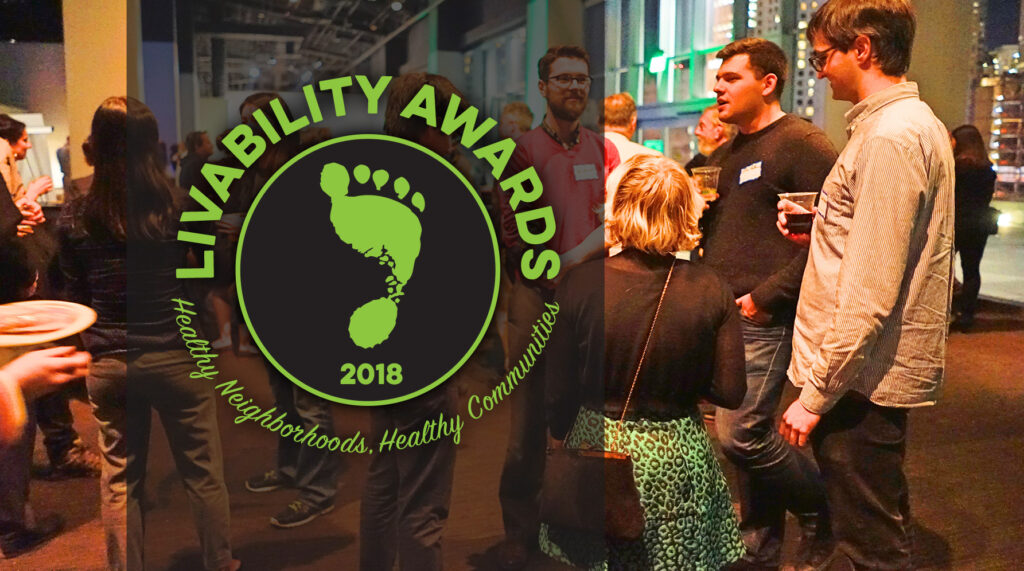
Join Livable City and friends for our annual fundraiser and awards ceremony to honor San Francisco’s most dedicated livability advocates who work at the intersection of land-use, environment, public health, and social equity in the Bay Area on Wednesday, June 20, 2018 from 5:30 PM – 9:30 PM.
You’ll enjoy an evening of great food, drinks, and celebration in the beautiful Gray Area Theater, all while supporting the important work of the 501(c)3 nonprofit Livable City.
Raise a glass with the region’s political, government, and business communities in celebrating this year’s distinguished honorees including San Francisco’s Director of Health, Barbara Garcia and The San Francisco Foundation with Executive Director Fred Blackwell accepting on behalf of the organization.
For more information about the Awards, including past recipients, click here.
2018 AWARDEES
The San Francisco Foundation As one of the nation’s largest community foundations, The San Francisco Foundation has been a touchstone for countless community organizations in the Bay Area. With Fred Blackwell at the helm, the foundation has taken their People, Place, and Power strategy to the next level, putting racial and economic equity at the heart of their grantmaking. Livable City recognizes TSFF’s important investment in Mission Economic Development Agency (MEDA)’s Small Sites Program, which has allowed the organization to acquire multi-family rental properties in the Mission to preserve and/or revert them to permanent affordable housing for low and middle income families.
Barbara Garcia, Director of San Francisco’s Department of Public Health Under Barbara Garcia’’s leadership, San Francisco Department of Public Health has championed rigorous, evidence-based, and innovative approaches to drug addiction, street safety, and healthy eating and active living. DPH has been a key partner in two initiatives Livable City is deeply involved with – Vision Zero, San Francisco’s initiative to eliminate traffic deaths and injuries by 2020, and San Francisco’s Shape Up Coalition, a multidisciplinary collaborative committed to reducing chronic disease health disparities across San Francisco communities. Most recently, Barbara has championed safe injection sites to improve health outcomes and access to services for people with drug addiction.
Mission Economic Development Agency (MEDA)
Rooted in the Mission and focused on San Francisco, MEDA’s mission is to strengthen low- and moderate-income Latino families by promoting economic equity and social justice through asset building and community development. MEDA’s services range from free tax preparation, business development, and job training to housing counseling and home-buying assistance. Livable City recognizes MEDA’s innovative Small Sites Program that will help stabilize 120 units of affordable housing and put MEDA on track to realize their vision of creating 1,020 housing units and 10,000 square feet of commercial space by 2020 to help protect Mission District families, small businesses, and community services from displacement.
Chema Hernández Gil is the political coordinator of San Francisco Rising, an electoral alliance building political power of working-class communities of color, and board director and co-founder of Seed the Commons, a grassroots organization working to create sustainable and just food systems independent of animal exploitation. Chema also serves as Board Director at the San Francisco Bicycle Coalition and The East Cut Community Benefit District, as well as an Executive Committee Member of the Sierra Club. His comprehensive organizing spans many interconnected areas, including social justice, human rights, the environment, sustainable transportation, and animal welfare.
Homeless Youth Alliance develops relationships with youth and young adults aged 13-29 who live on the street in the Haight Ashbury neighborhood of San Francisco, striving to empower young homeless people to protect themselves, educate each other, reduce harm within the community, and when they are ready, transition off the streets. HYA provides one-on-one counseling, mental and medical health services, and syringe access and disposal. After losing their drop-in center in 2013, HYA began providing services via their street outreach team, where they make over make over 12,000 contacts per year through their model of accessible, non-judgmental outreach and harm reduction.
—
2018 SPONSORS
GOLD
SILVER
Marc Babsin & Marianne David // San Francisco Giants
BRONZE
HNTB // Bert Hill // Jose Campos // Kodorski Design // Ocean Avenue Association
Residential zoning districts encompass 70 percent of San Francisco’s private land. Current zoning permits only one or two units per lot on most of the City’s residentially-zoned land. As the housing crisis in San Francisco and the Bay Area worsens, and as the City and the region continue to struggle with transportation and sustainability, the practice of exclusionary zoning – zoning that segregates people by income or economic class – is coming under increasing scrutiny.
Exclusionary zoning practices:
Segregate neighborhoods by income
Make housing less affordable
Limit housing choices for moderate and low-income households
Exclude new residents from transit-rich areas and abet sprawl development.
Privilege driving and parking over walking, cycling, and transit.
Defenders of low-density residential zoning counter with appeals to defend the established character of neighborhoods, and concerns about the effects of increased density and more residents, particularly on parking and traffic.
Recent changes to San Francisco and state law have opened up areas of low-density residential zoning to more housing and more diverse housing by legalizing accessory dwelling units. In December, San Francisco eliminated minimum parking requirements in residential districts, which allows housing to expand into existing garage spaces, and reduces the cost of building new housing. Ordinances permitting accessory units in new construction, and permitting new cottages on corner lots and through lots, will soon be considered by our Board of Supervisors.
Even bigger changes could be on the way. SB 50, a bill by Senator Scott Wiener that would radically alter residential zoning controls in transit-rich areas of California, including most of San Francisco, will be debated in the state legislature this year.
San Francisco, with its progressive and environmental values, ought to be in the forefront of reforming exclusionary practices. But over half the city’s land area is still subject to exclusionary zoning. There’s an increasingly clear way forward for San Francisco to reduce economic exclusion, diversify income-segregated neighborhoods, and expand housing opportunities, while preserving the character and livability of neighborhoods, preventing the loss and displacement of existing housing and residents, and improving access and expanding sustainable mobility in neighborhoods. San Francisco should be a leader, not a laggard, in reforming residential zoning.
Exclusionary zoning in San Francisco
Exclusionary zoning can be defined as “a legal practice that has been used for decades to keep lower-income people—disproportionately racial minorities—out of wealthy and middle-class neighborhoods across the country.” As legislative analyst Elliott Anne Rigsby explains:
“The Fair Housing Act prohibits discrimination based on race, color, national origin, religion, sex, ability, and familial status. Notably, however, it does not prohibit class-based discrimination. As a result, the Fair Housing Act provides a loophole for discrimination that confines low-income people to certain neighborhoods by systematically preventing them—through economic tactics such as minimum lot size and other expensive requirements—from moving into areas of with access to opportunity.”
San Francisco’s high housing prices mean that exclusionary zoning excludes not only low-income households, but increasingly middle-income households.
San Francisco exclusionary practices include strict density limits – limiting the number of dwelling units per lot to one or two units. It also includes minimum lot sizes, prohibitions on secondary buildings, and how dwelling units are defined. Exclusionary zoning prohibits many missing middle housing types – multi-unit or clustered housing types compatible in scale with single-family houses.
Residential zoning districts cover a majority of San Francisco’s private land. RH-1 zoning, which permits only only one house per lot, covers 27 percent of all San Francisco’s private land. RH-1-D, which permits only one house per lot and requires side yards between buildings, covers another 11 percent. RH-2 districts, which permit a maximum of two units per lot, cover 16%. RH-3 districts cover 5%, and RM districts, which permit a mix of houses and apartments, cover 9%. Transit-oriented residential districts like RTO, RED, which have no density limits or parking requirements, cover only 2% of the city. 37% of the city’s private land is zoned for only one unit per lot, and a majority of the city’s private land is zoned for a maximum of either one or two units.
Most of San Francisco was built prior to the imposition of zoning laws after World War II, and most of the City’s neighborhoods evolved for decades without zoning. This created the diversity of housing types and uses that one sees in most older San Francisco neighborhoods – single-family houses mixed with houses of stacked flats and apartment buildings, cottages and carriage houses tucked in the back of lots or along alleys, and storefronts at street corners or lining public transit routes. The imposition of zoning in San Francisco severely limited opportunities to add housing or diversify housing in neighborhoods. Strict density limits made the addition of new units, whether in new buildings or existing ones, illegal. The zoning of San Francisco also made over 50,000 existing units ‘nonconforming’ – denser than the new zoning allowed – and encouraged the removal of non-conforming units. Minimum parking requirements made housing more expensive to build, made it practically infeasible to add or divide units in many instances. Parking requirements also degraded neighborhood character by proliferating garage doors and driveways instead of front gardens and generous porches.
Beyond exclusionary zoning
While all zoning excludes something, ending exclusionary zoning doesn’t mean doing away with zoning altogether. Zoning done right can contribute enormously to the livability of cities, and can do much more to preserve and foster inclusion and diversity than laissez-faire approaches. San Francisco’s current zoning is a complicated mix of practices which institutionalize exclusion and others which promote inclusion. Progressive reform of San Francisco’s planning and zoning laws can reduce exclusion and instead foster inclusion, affordability, and livability.
It makes sense to limit development in environmental hazard zones – areas subject to flooding or coastal erosion, and steep slopes subject to fire and landslides – and to protect historic buildings and unspoiled areas of wild habitat and scenic beauty. It also makes sense to separate housing from certain incompatible uses, like heavy industry. Zoning can limit the size of new buildings and building lot coverage to respect the established built character of neighborhoods, provide public and private open space, and preserve residents’ access to sunlight, greenery, and views.
Sometimes, ‘preserving neighborhood character’ is code for a desire to exclude – not wanting to live near renters or lower-income people. But often neighborhood character means the things we love about our neighborhoods – distinctive and historic architecture, mature trees, gardens, and green open spaces, and established residents, businesses, and community institutions. We can reject exclusion while embracing character, and insisting that new development respect and enhance the character of neighborhoods.
San Francisco’s exclusionary zoning often serves to erode character. In most of the city, it’s easier to build an oversized monster home than to build a modestly-sized three-unit building, or add a rear cottage to a lot with a modestly-sized house. As many cities with overheated real estate markets are finding, zoning codes that permit only ever-larger single-family homes while excluding modestly-sized multi-unit housing are eroding both housing affordability and the built character of neighborhoods.
Many cities are turning to form-based codes to preserve and enhance neighborhood character while adding compatible new housing and commercial uses to neighborhoods. Unlike conventional zoning, also known as Euclidean Zoning, which typically hard-wires exclusion, form-based codes can build-in housing diversity by accommodating diverse housing types in a given neighborhood, including those in the ‘missing middle’.
Creating housing diversity by embracing the missing middle
The ‘missing middle’ includes a range of housing types compatible in scale with single-family houses, but which allow greater density and variety than currently permited by single family zoning in San Francisco and elsewhere. It includes familiar San Francisco housing types, like townhouses, stacked flats, and cottages, and types like courtyard apartments and bungalow courts seldom seen in San Francisco but common in older neighborhoods in other California cities. Legalizing the missing middle means relaxing current zoning limits on density. To accomodate some missing middle types, zoning can allow small residential buildings on both the front and rear of a lot, or to provide open space in a central court rather than a rear yard.
Both San Francisco and California law now allow one accessory dwelling unit (ADU) on any residential lot. ADUs in San Francisco must be within an existing building, including detached cottages and garages, and cannot expand into an existing residential unit. ADUs can be built in parking spaces, and can be built without off-street parking. Under current San Francisco law, ADUs can’t be built at the same time as the main dwelling; they can only be added to a main dwelling that’s at least three years old. Allowing ADUs to be built at the same time as the main dwelling would decrease the cost and disruption of adding ADUs, and encourage more of them to be built.
San Francisco also prohibits new housing at the rear of a lot, which mostly prohibits new cottages. Cottages are only permitted at the rear of a lot if the lot has street frontage at both ends (typically lots that run between a street and a rear alley) and if both adjacent lots already have residential buildings at the rear of the lot. However a garage is permitted at the rear of any lot. Changing the law to allow required rear yard space to be located between a front dwelling and a rear cottage instead of only at the back of a lot would permit many more cottages without eliminating mid-block open space. Vancouver legalized small cottages along residential alleys in 2010 (known locally as laneway houses) and the city now has over 2000 new laneway houses. San Francisco has fewer residential alleyways, but enough for laneway houses to make a contribution to housing diversity in the neighborhoods which do.
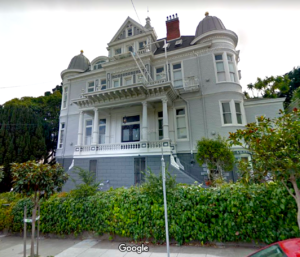
The Alfred E. Clarke Mansion, also known as the Caselli Mansion, on Caselli Avenue in the Castro. This Victorian mansion, built as a single house, was divided into 15 apartments of various sizes.
Another strategy that permits more housing and more affordable options in low-density neighborhoods is to remove the City’s minimum lot size requirements. San Francisco’s Planning Code requires a minimum lot size of 2500 to 4000 square feet. Permitting smaller lots would allow smaller and more affordable houses, including ‘pocket neighborhoods’ of row houses or cottages with individual or shared yards.
In the RH-1-D districts which require side yards, new detached multi-unit buildings could be permitted, or existing buildings divided into two or more units. Detached cottages can be built at the rear of lots. These strategies would conserve the established character – detached buildings set in yards and gardens – while adding new housing and diversifying housing opportunities.
Accomodating diverse households
San Francisco households are increasingly diverse, and planning and zoning for residential neighborhoods should accomodate that diversity by permitting both a greater variety of households, and by permitting households to adapt buildings to meet changing needs.
A dwelling unit is defined in the Planning Code as “a room or suite of two or more rooms that is designed for, or is occupied by, one family doing its own cooking therein and having only one kitchen.” A “Family” may include single people, and unlimited number people related by blood, marriage or adoption along with ‘necessary domestic servants’ and three or fewer roomers or boarders, or five or fewer unrelated persons. Many of the rules in the Planning Code, including the limitation to one kitchen and restrictions on full bathrooms in ‘rooms down‘, are aimed at disallowing the creation of additional units. However these restrictions can make housing less suitable to different sorts of households – households with three generations living under the same roof, seniors who wish to live independently but close to a family member or caregiver, or intentional communities, like co-housing. Since both San Francisco and the state now permit at least one accessory dwelling unit in any residential building, the planners’ imperative to control the details of dwellings’ interior layout makes little sense. It still makes sense to limit the loss of existing dwelling units, but there’s no good reason to ban second kitchens, or a ground floor bedroom with a full bath.
Many of the strategies discussed so far allow for smaller houses and smaller units. The City should also consider strategies which preserve or create units suitable to larger households. When the City created transit-oriented residential districts a decade ago, some of the Supervisors were concerned that removing density limits would result only in studios and one-bedroom units, and limit housing opportunties for larger households, especially households with children. In response, the transit-oriented districts included controls which require at least 40% of units in multi-unit buildings to have at least two bedrooms. The controls also require that at least one large unit be retained when existing large units divided into two or more units.
Current law permits the creation of accessory units in garage spaces, but in most residential districts it’s still illegal to expand living space for existing dwelling units into garage spaces. Households should be able to expand living space into car-storage space if their household gets bigger.
Neighborhood architecture: continuity and transformation
Most San Francisco neighborhoods were originally laid out with a pattern of gridded streets, and small narrow lots with individual houses, or sometimes multiple flats. With the exception of a few set-piece neighborhoods encumbered with restrictive covenants, most San Francisco neighborhoods diversified over time – some houses were divided into apartments, some smaller buildings replaced with larger apartment buildings, and corner stores were added here and there, including raising up wood-framed residential to add storefronts on the ground floor. These transformations were documented in Anne Vernez Moudon’s Built for Change: Neighborhood Architecture in San Francisco. The apartment buildings built in the first half of the 20th century were generally larger than neighboring houses, and increased residential density. They mostly proved to be architecturally compatible, even when they were in built in contrasting styles like Art Deco or Mediterranean Revival. Their designers articulated buildings into a base, middle, and top, used similar rhythms and proportions for features like window bays and entries, and used ornament to provide visual interest and human scale.
Designers of buildings built after World War 2 mostly rejected continuity with existing neighborhood architecture. Some of the biggest changes came at street level. Instead of a residential building base and generous front entries, buildings built from the mid-20th century on devoted building ground floors to parking. It was partially in response to increased auto ownership, but also in response to changing zoning codes. In 1955 San Francisco imposed minimum parking requirements citywide. Multi-unit buildings typically dedicated the entire ground floor to parking to meet requirements, and garage doors and open carports came to dominate ground-floor building fronts, especially on narrow lots. Another factor was the imposition of a 40′ height limit across most of the city. Builders couldn’t lift the ground floor units a few feet above the sidewalk for livability and privacy, as older buildings do, without sacrificing an upper floor, so they typically defaulted to parking on the ground floor, with residences only on the second floor and above.
The new planning requirements imposed between 1955 and 1960 – strict density limits, strict height limits, minimum parking requirements, and the prohibition of non-residential uses in residential districts – mostly outlawed the sort of incremental development that had previously diversified neighborhoods. Builders could only add new one- or two-unit buildings. These buildings were typically boxy and larger than neighborhood buildings, and were pejoratively labeled “Richmond Specials” after the San Francisco’s Richmond District where they were common. Neighbors’ objections to ill-fitting new buildings – apartment buildings in the neighborhoods where they were still permitted, and Richmond Specials elsewhere – boiled over in the 1970s. As Anne Vernez Moudon observed, “Such widespread discontent make it clear that the problem was not only overdevelopment, but also the ‘fit’ (or lack thereof) between new structures and the existing context; issue was as much the character as the scale of new development”. In 1978 Planning Department responded by lowering allowable density even further in some neighborhoods, and crafting residential zoning controls and design guidelines that limited the size of new buildings and building additions to conform more closely to adjacent buildings. The 1970s zoning reforms maintained core elements of the 1960 zoning framework like use restrictions, density limits, and minimum parking requirements.
As San Francisco and most other cities were imposing citywide minimum parking requirements, segregation of uses, and strict limitations on density, urbanists were critiquing the negative effects that postwar planning conventions, also called Euclidean zoning, had on cities. Jane Jacobs’ The Death and Life of Great American Cities remains one of the most popular and durable critiques. Jacobs argued that city neighborhoods can be both dense and livable, that a mix of uses benefits city neighborhoods, that sidewalks were essential neighborhood public spaces, and cities should be walkable rather than dominated by the automobile. As Jay Wickersham observed:
Jacobs shows us that Euclidean zoning has been hard where it should be soft and soft where it should be hard. Zoning has been hard, or overly rigid, in dividing our cities and towns into uniform, low-density districts, each dedicated to a single primary use. And zoning has been soft, or overly permissive, in its failure to set design standards for streets, and for how buildings front upon those streets, that would reinforce the fundamental character of streets as public spaces.
Form-based codes, as described above, integrate the insights of Jacobs and others into plans and regulations intended to create urbane and walkable neighborhoods, and include looking to older livable and lovable buildings and neighborhoods for patterns. Form-based codes typically pay more attention than Euclidean codes do to how buildings meet the street and how they shape and engage the public spaces around them – streets and sidewalks, and rear yards – and to architectural standards. Form-based codes for urban neighborhoods also relax the strict segregation of uses, as well as strict density limits and minimum parking requirements. San Francisco’s current code remains largely Euclidean, with form-based elements grafted on. A form-based code for San Francisco’s residential neighborhoods could allow more and more diverse housing options in neighborhroods, while conserving and enhancing the desirable built qualities of neighborhoods, and even allowing some of the damage done in recent decades to be repaired as buildings are renovated or replaced.
Preserving and expanding affordability in residential districts
Most of the strategies discussed so far are ‘affordable-by-design’ strategies, aimed at incremementally adding housing in neighborhoods, and providing more flexibility in accommodating both large and small households. However if we want truly diverse neighborhoods in an expensive city, we’ll need to strategies for preserving affordable rental housing in neighborhoods, and creating more permanently affordable units in all neighborhoods.
Preserving existing rent-controlled units in neighborhoods is key to preventing displacement of existing households. The city has limited condominium conversion in existing rental buildings, but residents are still being displaced by Ellis Act evictions and owner move-in evictions. For many households, a no-fault eviction means they can no longer afford to live in the neighoborhood, or even in San Francisco.
Units are also being lost to mergers. Mergers tend to increase as neighborhoods become more affluent, and unit mergers reduce the supply and diversity of housing and make what remains more expensive. Until 2014, the Planning Code encouraged the merger of units which exceeded current density limits. This policy resulted in the loss of many rent-controlled and affordable units in San Francisco. Livable City worked with the Board of Supervisors to amend the Planning Code to discourage mergers, regardless of whether they exceed current density limits. The new controls have saved many units that would formerly have been lost, but includes a loophole allowing ‘demonstrably unaffordable’ units to be merged. Because of San Francisco’s surging housing costs, the unaffordable threshold is now over $1.6 million, but in San Francisco’s most expensive neighborhoods, virtually all housing exceeds the threshold. This loophole may allow the merger of seven large apartments on Presidio Avenue into two units, with one exceeding 11,000 square feet. Mergers like this are making already unaffordable neighborhoods less diverse, and even less affordable.
Affordable housing developers tend to avoid building in low-density neighborhoods, mostly because what they can build is so limited that it makes more sense to build where greater density is permitted. The City’s recently adopted HOME-SF program, which allows more density and larger buildings for projects which are 100% affordable or which include more affordable units, explicity exempts land in RH-1 and RH-2 districts, which will further limit affordable housing opportunities in residential districts. One opportunity to create more affordable housing in residential neighborhoods is to expand the City’s Small Sites Acquisition Program, which provides grants to nonprofit housing providers to purchase existing rental housing and keep it permanently affordable.
Sustainable mobility and ten-minute neighborhoods
Anxiety about transportation, particularly traffic and parking, is one of the most common rationalizations for limiting density in residential districts, and are among the most frequently-raised objections to new housing in neighborhoods.
Most of San Francisco’s residential neighborhoods were developed as streetcar neighborhoods, and retain their walkable patterns – small residential lots, pedestrian-scaled streets and blocks, neighborhood-serving commercial districts along the main transit corridors, and corner stores. Only a few post-World War 2 neighborhoods were built on an automobile-dependent pattern. According to Walk Score, San Francisco has an average walk score of 86 (“very walkable”).
Most of San Francisco’s residential neighborhoods are served by transit. According to SFMTA, 95 percent of the City’s addresses are within two blocks of a MUNI stop.
As we wrote in our posts on retail and the livable city, the city has a strong foundation for ten-minute neighborhoods – neighborhoods where most of the requirements of daily life, including grocery stores, shops, services, schools, a library, and frequent public transit, are with ten minutes walk. San Francisco can now boast that every San Franciscan lives within ten minutes walk of a City park. Ten-minute neighborhoods should be a foundational City policy in the our general plan and neighborhoood plans. As one measure, San Francisco should aim to achieve a walk score of 90 (“pedestrian paradise”) for every San Francisco neighborhood. Fostering ten-minute neighborhoods will expand access and opportunity and improve livability for existing residents, and allow neighborhoods to add housing and new residents without increasing traffic congestion. Increasing the density of residents is a key strategy for fostering neighborhood-serving shops and services. Transportation surveys of San Francisco’s neighborhood commercial districts found that the overwhelming majority of shoppers walked, bicycled, or took transit.
Most residential districts need better management of off-street parking. On most residential streets curb parking isn’t managed at all – anyone may park as many cars as they like on the street, at no cost, for as long as they like, moving them only on street-sweeping days where those exist. Since driveways eliminate curb spaces, requiring off-street parking also decreases the number of on-street spaces, with no guarantee that the off-street spaces will actually be used to store a car. Where there’s competition for curb parking, requiring off-street parking isn’t likely to create free and abundant off-street parking; only managing street parking better will improve parking availability.
San Francisco can continue to expand shared and sustainable transportation options in neighborhoods – car-share within convenient walking distance of residents, and shared bicycles and scooters, including electric bikes and scooters to serve hilly neighborhoods and older residents.
An Action Plan for reforming residential zoning
We have seen some successes since our residential zoning reform plan was published a year ago. The City eliminated minimum parking requirements at the end of 2018. Ordinances permitting new cottages on corner lots and through lots, and accessory units in new buildings, will be considered by the Board of Supervisors this year.
Beyond exclusionary zoning
Eliminate strict lot-area density limits, and instead limit density by height limits and lot coverage limits, residential open space requirements, dwelling unit exposure requirements, and required dwelling unit mix.
Eliminate minimum lot-size requirements.
Eliminate conditional use requirements for small and medium-sized which conform to zoning requirements and complete required design review.
Embrace the missing middle
Permit small cottages at the rear of a lot, with a yard in between buildings.
Allow more flexibility with yard and setback requirements to permit apartment courts and cottage courts.
Accomodating diverse households
Relax limitations on second kitchens and ‘rooms down’.
Allow living space to expand into garage spaces.
Require at least 40% of units in new multi-unit buildings to be two or more bedrooms.
Limit the division of large units to preserve at least one multi-bedroom unit.
Neighborhood architecture
Expand requirements and incentives to preserve existing character-defining buildings.
Integrate planning code requirements and residential design guidelines into an cohesive set of standards.
Limit the width and location of garage entrances.
Strengthen greening and permeability requirements for front and rear yards.
Preserving and expanding affordability
Strengthen protections against speculative evictions and the conversion, demolition, or merger of rent-stabilized housing.
Provide technical, design, and financial assistance to homeowners who wish to add an accessory dwelling unit, or legalize an existing unpermitted unit, if they agree to keep it as a rental for a certain number of years.
Eliminate the ‘demonstrably unaffordable’ loophole in merger restrictions.
Expand funding for the Small Sites Acquisition program to preserve affordable rental housing in neighborhoods as permanently affordable.
Walkable neighborhoods and sustainable mobility
Improve Muni service in neighborhoods, including faster service between neighborhoods and downtown, and timed transfers between neighborhood bus routes and rail lines.
Make every neighborhood a ‘ten-minute neighborhood’ by zoning for neighborhood-serving commercial districts within walking distance of each neighborhood, permitting corner stores, strengthening City initiatives that support neighborhood retail businesses, and locating community facilities like libraries, elementary schools, parks, playgrounds, and recreation centers within convenient walking distance of all neighborhoods.
Invest in pedestrian and bicycle safety (Vision Zero) and neighborhood-scale traffic calming, including safe routes to schools and safe routes to transit.
Expand shared mobility services in neighborhoods – car-share, bike-share, and scooter-share.

 January 31st, 2019
 On December 21, the Mayor signed Supervisor Jane Kim’s ordinance eliminating minimum parking requirements citywide. The ordinance goes into effect on January 20.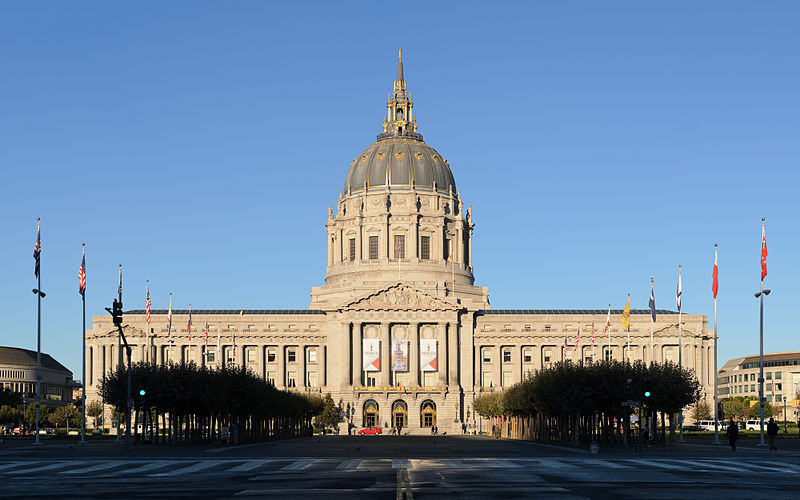

 The San Francisco Foundation
 Barbara Garcia, Director of San Francisco’s Department of Public Health
 Mission Economic Development Agency (MEDA)
  Chema Hernández Gil
 Homeless Youth Alliance

 SILVER