
A lot is at stake in the November 3 Election. Will public transit keep improving, or suffer devastating service cuts? Will Sunset Dunes, San Francisco’s popular new oceanfront park, be turned back into a highway? Will San Francisco make the investments necessary to put decent housing in reach for most San Franciscans?
Making the right choices this November can put us on a path towards a better and more livable San Francisco and Bay Area, or set us back. Let’s choose the better future together. Livable City recommends yes on Measures C, H, I, and RTM, and no on Measure G.
Yes on RTM and H to save public transit
Public transit is crucial to livability. Public transit is freedom – the freedom to access everything from work to education, recreation, community, culture, and nature. It is also a foundation for creating the sorts of walkable, diverse, and healthy communities where we can thrive.
Public transit in the Bay Area has seen a steady improvement since the pandemic. Wise capital investments, including Caltrain modernization, the renewal of BART trains, tracks, and systems, and programs like Muni Forward to improve Muni speed, reliability, and accessibility, are delivering better service. Better service is attracting riders back post-pandemic, and where service has been improved – on crosstown Muni lines, and evening and weekend and evening Caltrain service – ridership is higher than before the pandemic. However the funding to operate our multi-generational investments in transit is disappearing. Federal and state support for public transit has been declining, and the Federal pandemic recovery funding boost for transit is now gone. Unless we replenish transit funding with City and regional sources. we will very quickly see devastating cuts to transit frequency and coverage, more overcrowding, and more pollution and automobile congestion, and the decline or loss of mobility options – freedom – for all of us. Fortunately two companion measures, placed on the ballot by voter petitions, will stabilize transit funding and allow it to keep getting better.
Measure RTM is a regional measure which funds BART, Muni, AC Transit, and Caltrain operations. It would create a new half-cent or quarter-cent sales tax in five counties – Alameda, Contra Costa, San Francisco, San Mateo, and Santa Clara – which sunsets in 15 years. If it passes, measure RTM would cover the forecast operating deficits for BART, Caltrain, and AC Transit, and a portion of Muni’s forecast operating deficit.
Measure H would fund the remainder of Muni’s forecast operating deficit, and provide an additional $10 million or so to improve service where it’s most needed. it is funded by an innovative progressive parcel tax, structured so that more valuable commercial properties pay a proportionally greater share than smaller and residential properties, and it also sunsets after 15 years. In order to cover the entirety of Muni’s operating deficit both Measure H and Measure RTM must pass.
Save Sunset Dunes Park – vote No on G
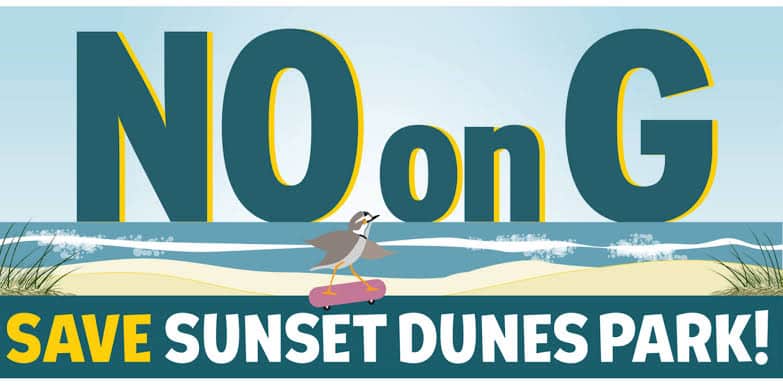
Two years ago San Franciscans voted to transform the former Great Highway into Sunset Dunes, a popular oceanfront park. Sunset Dunes become the third most popular park in San Francisco, and the City and philanthropy keep adding new amenities to serve more and more diverse groups of park users. Proposition G would destroy the new park by re-opening the highway five days a week. Doing so would preclude recreational use on most days, and necessitate removing any permanent park amenities like seating, play areas. It would also preclude reconfiguring the park to save Ocean Beach. Beaches are dynamic, reshaped constantly by waves, wind, tides, and currents. The Ocean Beach Master Plan, completed over a decade ago, concluded that keeping the highway in place could ultimately destroy the beach, leaving only a seawall between the ocean and the highway.
Proponents claim that restoring the highway will reduce automobile congestion and shorten car commutes. But the promise that highway expansion will solve congestion has proved false over and over again for decades. Highway expansion generates induced demand, which typically brings congestion back to pre-expansion levels quickly and at an enormous health, environmental, and financial cost. For decades highway builders have devastated neighborhoods, waterfronts, and green open spaces by promising to relieve congestion, and over and over again it has proved to be a false promise. The true alternative to traffic congestion is creating more walkable and bikeable streets and neighborhoods, and improving public transit options.
We are also growing aware that people are happier and healthier in and around nature. Livable cities give every home a view of greenery, have trees and sidewalk gardens on every street, and put every home within a short walk of a park or green open space. People are attracted to water and it puts our minds and bodies at ease. Parks like Sunset Dunes help heal our oceans and help us heal ourselves.
Yes on C and I for a more affordable San Francisco

Every San Franciscan deserves to be decently housed in a livable neighborhood at a price they can afford. To get there from where we are now much will have to change. Measures C and I will help put us on the right path.
For a quarter century Livable City has been working to make good housing in livable neighborhoods more accessible to more people. We took the lead on legalizing accessory units and four- to six-unit buildings on every residential lot in San Francisco. We led a successful multi-year effort to legalize housing without parking. We championed a path to legalization and building code compliance for tens of thousands of nonconforming units. We helped shape and enact community plans that increased the amount of housing permitted while stabilizing existing residents and businesses and improving streets, open spaces, and transportation.
While private development can meet the housing needs of many San Franciscans, many more are unable to afford what the private housing market is able to produce. To meet the housing needs of everyone we need a renewed civic commitment. Many of the funding sources once used to build permanently affordable housing have been disappearing. Over a decade ago the State ended redevelopment, which San Francisco had been using since the 1970s to finance new affordable housing and replace housing destroyed by urban renewal. Federal support for affordable housing has been in long-term decline. And this year the Board of Supervisors reduced the inclusionary affordable requirements on new market-rate housing in an effort to jump-start private housing construction in the City, which has been stagnant despite many recent pro-housing zoning changes.
Measures C and I will restore lost funding by dedicating small portions of the City’s future tax revenue to construct or rebuild permanently affordable housing, purchase existing rental housing and keep it permanently affordable, and provide short-term rent assistance to keep vulnerable San Franciscans from losing their homes. Neither measure raises taxes. Measure C creates a small set-aside from the City’s general fund, which will grow each year pausing only in bad economic times. Proposition I dedicates a portion of the current real estate transfer tax on large commercial properties and expensive homes to affordable housing construction, rehabilitation, and acquisition.
No one reform will create affordability for all, but many complementary reforms will be transformative. Measures C and I are important steps forward, and deserve your support.